




The Off-Rez & Un-Confiscated Archive
Volume I: Rez Gatekeepers & the Policing of Indigeneity
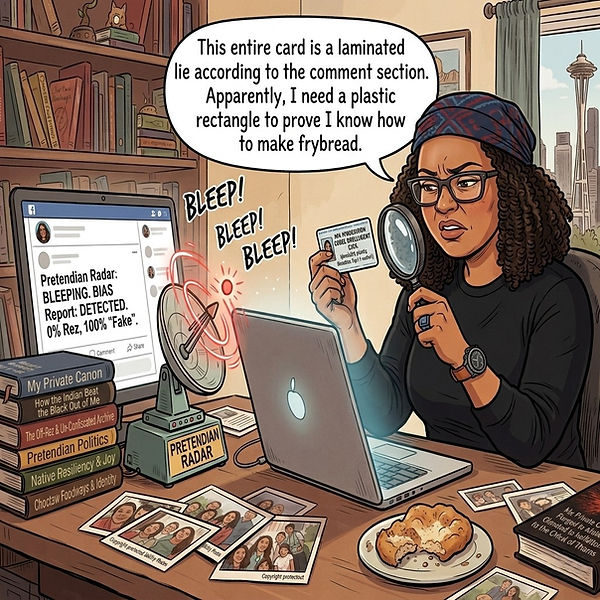
Oh, so you stumbled onto my page and your “Pretendian Radar” started bleeping? You thought to yourself, “Wait, she’s a Seattle-based author who isn’t sitting on a reservation holding a laminated card stamped by Uncle Sam? Red flag!” So, let’s talk about the newest trend in online entertainment: the tribal identity bouncers. Lately, there is a whole subculture of internet detectives acting like self-appointed tribal police, desperately trying to erase my grandparents. They see one Black grandmother on my dad's side and suddenly decide my entire Indigenous lineage is canceled.
Oh, so because of her, I can’t be Indian, huh?
Apparently, to these internet experts, Black ancestry acts like a magical bleach for Indigenous blood. I am absolutely not ashamed of my curly hair, but it certainly doesn't change the womb I exited from! Trust me, my pokni sipokni would be throwing a beautiful, fluent stream of Choctaw curse words at you internet experts for trying to box her in with Whoopi Goldberg lookalikes.
Ofi tek! Whoa, where did that come from?
Here is the real tragedy: while these digital detectives are busy running weaponized Pretendian witch hunts against real, complex families, they are letting the actual frauds slide right past them. We are living in an era where people treat Indigenous heritage like a social media aesthetic—waking up on a Tuesday, buying a dreamcatcher on Amazon, and carouseling it on TikTok. Because the internet is flooded with these obvious cosplayers, the gatekeepers have gone into a hyper-paranoid frenzy. But instead of catching the fakes, they end up flushing out the real ones based entirely on an algorithm. If you aren't wearing curated turquoise, matching the visual aesthetic of a Hollywood extra, or posting your exact enrollment fractions in your bio like a digital badge of authority, they deem you canceled. They’ve turned our literal survival into cheap content, farming outrage for likes, views, and algorithm points.
Which brings me to the absolute comedy of the Rez Gatekeeper. These online bouncers demand a plastic BIA card stamped by Uncle Sam and seem to think history froze the moment a family stepped off reservation lines. Newsflash: I am a proud non-rez NDN, making me part of the actual majority. Roughly 78% of Indigenous people do not live on reservations. If staying off the rez makes someone fake, then almost the entire Native population missed the memo. Are we supposed to deport ourselves back to a specific zip code just to satisfy a TikTok comment section?
Now, let's be completely clear: we do not base Indian heritage on skin color. That is non-Indian business. Indigenous identity is about lineage, kinship, and community survival—not a shade on a paint swatch. Yet these online bouncers love using skin tone as a weapon, throwing around insults that label Indigenous people as Siberians or treating our heritage like a generic geographical tag. Instead of respecting actual tribal lineages, they love slapping clinical, demographic buzzwords floating around online like “Black Indian” onto families like mine.
Let’s call that what it really is: a slick new form of erasure. By trying to flatten us into a hyphenated racial buzzword or an internet-subculture tag, they strip away our actual, specific tribal nationhood. They turn us into a modern political category instead of an actual relative with a distinct lineage. It’s the ultimate double-team: you’ve got White spaces refusing to see you as anything but Black, and Black internet spaces gatekeeping you out of your Native family tree because you don't fit a Disney cartoon stereotype. It’s almost like for us to exist, we have to place their heritage in front of the name Indian, or box ourselves into their categories just to be real or exist in Indian Country. They are using the same colonial, divisive logic that outside forces invented, all while claiming they are doing justice.
Our deep history on this continent starts and ends right here. So to the lovely neighbor who called me a wet back, threatened to call ICE on me, and yelled at me to “go back home”—good luck with that phone call. This is my home. Where exactly am I supposed to deport myself to? The other side of the yard? And honestly, to the branches of my family who actually did make it across that imaginary border line back in the day to escape the chaos: congrats, but we are both still broke anyway, so what did we really win? The border crossed the people, not the other way around, but try explaining that to someone whose entire worldview is shaped by a social media feed.
So before you internet Indians try to steal my family photos from my book and claim that you are somehow related to me—like some of the strange messages I am already receiving, cough, cough—just know those images are strictly copyright-protected and cannot be distributed or reproduced in any way. Don't go trying to AI my poor granny into your digital photo frames. She wouldn't appreciate it, and neither do I.
We are funny people. We laugh through the pain because if we didn't, we’d never stop crying. But let’s call a spade a spade: this new wave of internet gatekeeping is causing serious, real-time pain and erasure all over again. To my Indian brothers and sisters: yes, we may befriend or lie with non-Indians, but we cannot take on their issues and let them divide our families and communities again.
Oh, you thought I was going to write a massive essay trying to convince you by overexplaining the logistics of paper genocide or debating the math of blood quantum? Nope. If you want the deep, unfiltered breakdown of how our families actually survived outside the lines, you can buy My Private Canon: Forged in Malice, Chanted in Isolation to the Christ of Thorns. My ancestors' faces and those deeper histories are for my family and the readers holding my physical books—not for a random Google Image search or a 60-second video clip.
Now, I am signing off to go eat my ishki corncakes before she slaps me for letting them get cold. Honestly, I'm not even sure how the Mexican cornbread got into the mix here, but hey, that is a story for another time!

Historical & Archival References
-
Federal Census Data: U.S. Census Bureau, American Indian and Alaska Native Population Records (Non-Reservation Geographies & Urban Trends).
-
Bureau of Indian Affairs (BIA): Historical Records of the Allotment Era and the administrative creation of the Certificate of Degree of Indian Blood (CDIB).
-
The Racial Integrity Act of 1924 & Walter Plecker: Commonwealth of Virginia, Bureau of Vital Statistics (Documenting the "Paper Genocide" and forced reclassification of Southeastern Indigenous lineages).
-
Chief Joseph (Hinmatóowyalahtq̓it): Historical archives of the Nez Perce Resistance (1877) and the refusal of forced boundary treaties.
-
Sitting Bull (Tȟatȟáŋka Íyotake): Records of the Lakota Sovereign Resistance and the refusal of agency rations.
-
Hopi Alcatraz Imprisonment (1894): U.S. Department of the Interior / Bureau of Education records regarding the nineteen Hopi leaders who resisted forced BIA enrollment.