



The Off-Rez & Un-Confiscated Archive
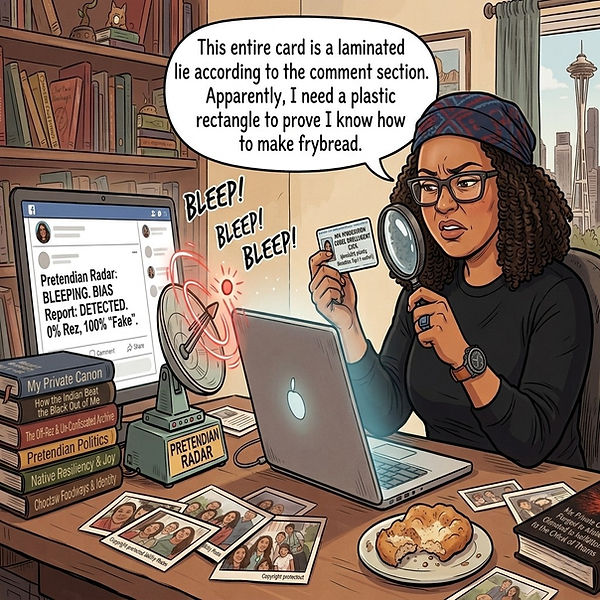
Oh, so you stumbled onto my page and your “Pretendian Radar” started bleeping? You thought to yourself, “Wait, she’s a Seattle-based author who isn’t sitting on a reservation holding a laminated card stamped by Uncle Sam? Red flag!” Well, you can keep right on thinking that if it helps you sleep at night. But while you're busy squinting at my bio, my family is busy making frybread, telling jokes everyone remembers differently, and carrying on traditions that the federal government quite literally forgot to index. We are non-reservation Indians—which basically means our ancestors were excellent at avoiding the census man, hiding out in plain sight, and keeping our culture alive without waiting for permission from a bureaucrat. Honestly, my family was so good at hiding from the government that my great-grandfather went by Banatha, Tomahawk, and half a dozen other names depending on who was asking. Good luck tracking that trail with a basic Ancestry.com subscription!
Let’s look at some real history and real numbers before you try to audit my lineage. According to official census data, the vast majority of Indigenous people—roughly 78% or more—do not live on reservations. If staying off the rez makes someone fake, then almost the entire Native population missed the memo. A tribal enrollment card was invented by the federal government, specifically the Bureau of Indian Affairs, to track rations and land allotments. A plastic ID card created by non-Natives doesn’t make someone more or less Indian; our ancestors didn't carry wallets; they carried bloodlines, languages, and foodways. For us, that heritage isn't an abstract concept; it’s preserved in the specific ways we handle ancestral staples, pass down traditional recipes, and keep our family's unique culinary lineages alive. Let's be completely clear: we do not base Indian heritage on skin color. That is non-Indian business. Indigenous identity is about lineage, kinship, and community survival—not a shade on a paint swatch.
If you think refusing to enroll or live on a government-mandated reservation means a person isn't authentically Native, you might want to argue with our historical icons. Chief Joseph of the Nez Perce famously fought a brilliant campaign to avoid being forced onto a reservation, stating that he would never trade the lands of his fathers for a government boundary. Sitting Bull of the Lakota spent years completely refusing to live on a reservation or accept government rations, choosing to live sovereign and wild in the old ways while famously stating that he would rather die an Indian than live a white man. Even in 1894, nineteen Hopi leaders under Chief Lomahongyoma were imprisoned on Alcatraz Island specifically because they refused to enroll their children in government boarding schools and resisted the federal reservation system.
When the U.S. government forced families onto reservations, they often stripped them of their names, languages, and sacred items. But for families who survived on the fringes—frequently targeted by historical paper genocide like Virginia's Racial Integrity Act or the bureaucratic erasure of registrars like Walter Plecker—our ancestors were reclassified by force. Grouped into categories like Free People of Color or Mulattoes in early southern registries, our history was intentionally obscured by institutions. Because of this, our traditions lived safely where the state couldn't touch them: in the kitchen, in our faith, in the traditional naming of our children, and in our oral histories. We don't look to a government agency for validation because our identity has always been anchored in the relational accountability and recognition of our actual peer communities and maternal networks. You can't revoke a lineage that was never registered with the people who tried to erase it in the first place.
If we are being completely honest about how those plastic BIA government cards were handed out in the first place, the history is hilarious if it wasn't so tragic. Back during allotment times, if an Indian family intermarried with white settlers, the government agents rolled out the red carpet, handed them a piece of paper, and stamped them as legitimate. But if our ancestors shook hands, lived alongside, or loved a Black neighbor? Boom—you got the boot, stripped of your status, and reclassified as something the aunties wouldn’t even recognize faster than you could blink. It turns out Uncle Sam’s original enrollment policy was basically: “White grandparents get you a card, but Black grandparents get you canceled.” Not all, of course.
Lately, there is a whole subculture of online social media groups acting like self-appointed tribal bouncers, desperately trying to erase our grandparents. They see one Black grandmother on my dad's side and suddenly decide my entire lineage is canceled. Oh, so because of her, I can’t be Indian, huh? Apparently, to these internet experts, Black ancestry acts like a magical eraser for Indigenous blood. I am absolutely not ashamed of my curly hair, but it certainly doesn't change the womb I existed from! Trust me, my pokni sipokni would be throwing a beautiful, fluent stream of Choctaw curse words at you internet experts for trying to box her in with Whoopi Goldberg lookalikes.
Ofi tek! Whoa, where did that come from?
They make it incredibly hard for people like me, completely forgetting that southeastern Native history is beautifully complex and deeply intertwined with families who survived outside the reservation lines. But hey, if those digital detectives want to spend their free time policing my family tree instead of getting a hobby, that is their business.
Our deep history on this continent starts and ends right here. So to the lovely neighbor who called me a wet back, threatened to call ICE on me, and yelled at me to “go back home”—good luck with that phone call. This is my home. Where exactly am I supposed to deport myself to? The other side of the yard? And honestly, to the branches of my family who actually did make it across that imaginary border line back in the day: congrats, but we are both still broke anyway, so what did we really win?
So before you internet Indians try to steal my family photos from my book and claim that you are somehow related to me—like some of the strange messages I am already receiving, cough, cough—just know those images are strictly copyright-protected and cannot be distributed or reproduced in any way. Don't go trying to AI my poor granny into your digital photo frames. She wouldn't appreciate it, and neither do I.
So, here we are at the end. Oh, you thought I was gonna write a massive essay trying to convince you by sharing private family photos or overexplaining myself? Nope. But you can certainly buy My Private Canon: Forged in Malice, Chanted in Isolation to the Christ of Thorns, so you can see just how NDN I am. My ancestors' faces are for my family and the readers who hold my physical books in their hands—not for a random Google Image search. At the end of the day, I know who my people are, my community knows who my people are, and that’s all the validation I need.
But let's call a spade a spade: this new wave of internet people is causing serious pain and erasure all over again. To my Indian brothers and sisters: yes, we may befriend or lie with non-Indians, but we cannot take on their issues and let them divide our families and communities again. This is wrong, and it needs to stop. But honestly? It may never stop. I strongly believe that those who are not of this land desperately want to convince themselves that we are dead—all so they can manufacture lies and stories to erase us for sport.
Now, I am signing off to go eat my ishki corncakes before she slaps me for letting them get cold. Honestly, I'm not even sure how the Mexican cornbread got into the mix here tonight too, but hey, that is a story for another time!
FUN FACT: Many Indigenous people today have ancestry connected to multiple tribes or nations. Generations of intermarriage, migration, adoption, and relationships between neighboring communities have created families with ties to several nations. Having lineage connected to more than one tribe is therefore a longstanding reality for many families.

Historical & Archival References
-
Federal Census Data: U.S. Census Bureau, American Indian and Alaska Native Population Records (Non-Reservation Geographies & Urban Trends).
-
Bureau of Indian Affairs (BIA): Historical Records of the Allotment Era and the administrative creation of the Certificate of Degree of Indian Blood (CDIB).
-
The Racial Integrity Act of 1924 & Walter Plecker: Commonwealth of Virginia, Bureau of Vital Statistics (Documenting the "Paper Genocide" and forced reclassification of Southeastern Indigenous lineages).
-
Chief Joseph (Hinmatóowyalahtq̓it): Historical archives of the Nez Perce Resistance (1877) and the refusal of forced boundary treaties.
-
Sitting Bull (Tȟatȟáŋka Íyotake): Records of the Lakota Sovereign Resistance and the refusal of agency rations.
-
Hopi Alcatraz Imprisonment (1894): U.S. Department of the Interior / Bureau of Education records regarding the nineteen Hopi leaders who resisted forced BIA enrollment.